
Accessible Math Empowers Educators by Providing Practical Teaching Strategies
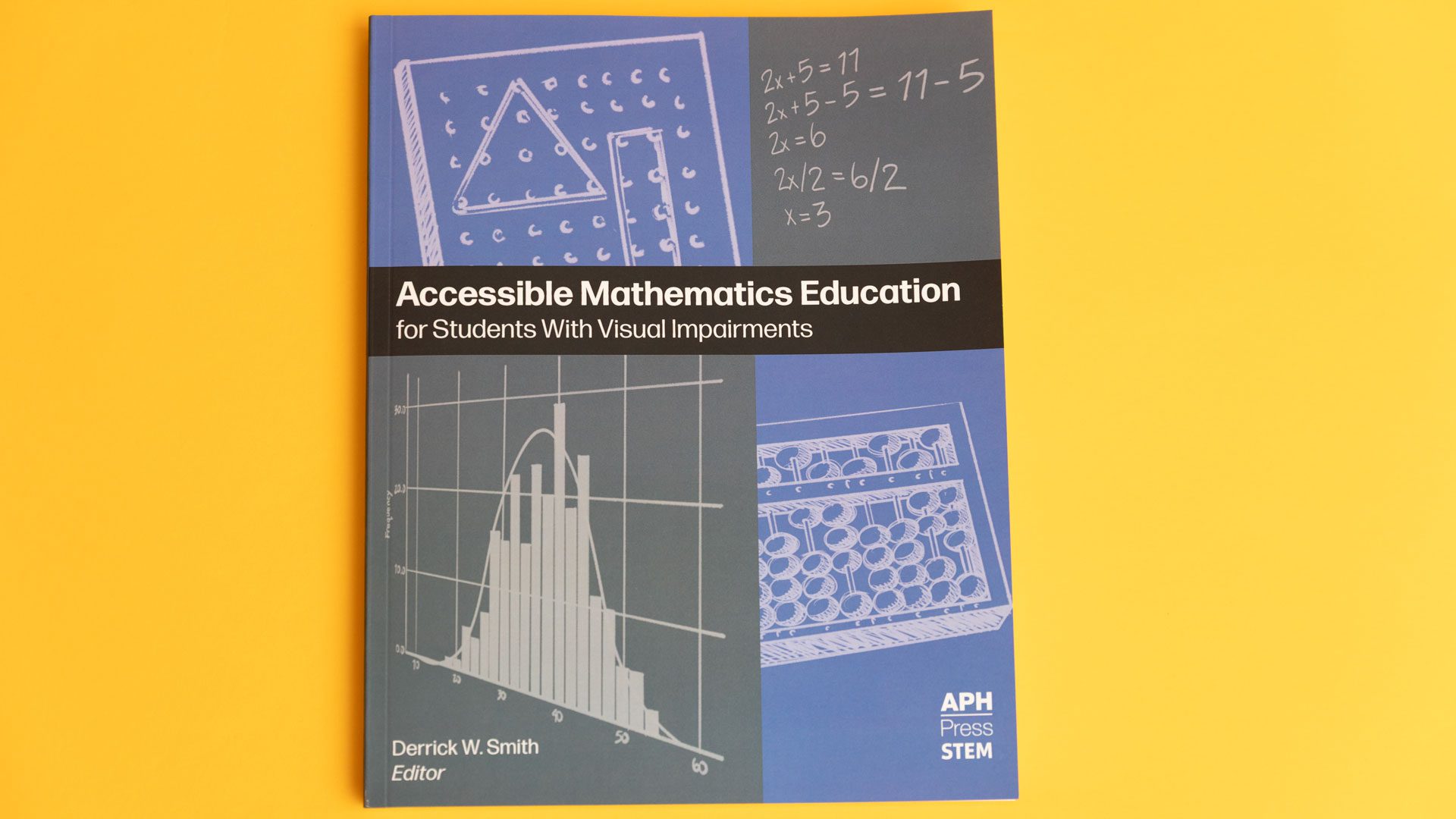
Even for the most passionate teachers, finding the right way to reach students who are blind or low vision may seem intimidating. This is particularly true in the STEM fields, where emotions can run high and new concepts are introduced frequently. Accessible Mathematics Education for Students With Visual Impairments, the newest entry in APH’s STEM series, empowers educators by providing practical teaching strategies from experts with direct experience adapting mathematics for students who are blind or low vision. Whether a reader is a Teacher of Students with Visual Impairments (TSVI) without a strong math education background or a math teacher who has never taught a student with blindness or low vision before, Accessible Mathematics will be a valuable tool in giving their students what they need to succeed.
To editor Derrick Smith, the need was obvious. “One of the most common comments about the challenges of supporting students with blindness or low vision in mathematics is that the TSVI is not a content specialist. I wanted to make sure this book would be beneficial for TSVIs, general education math instructors, and anyone else who supports students with blindness or low vision.”
Smith is well-suited to be the editor of this book: he has been teaching math to students who are blind or low vision ever since he took a chance on a job at the Alabama School for the Blind. That job was initially humbling—there was so much he didn’t know about teaching, let alone teaching students who are blind or low vision. But it also gave him a lifelong passion for his students that he’s carried throughout his career, which includes fifteen years as a special ed faculty member at the University of Alabama in Huntsville and a decade as dean of the College of Education at Auburn University at Montgomery, which will welcome its first TSVI cohort this fall. Along with his expert team of authors, he’s created the book that his younger self needed.
“All of the authors were encouraged to spend time explaining major math concepts that may be the most challenging for students with blindness or low vision to learn,” Smith says, citing the concepts’ traditionally visual nature. For example, Smith notes, “something as simple as how a fraction is written is dependent upon the spatial arrangement; that vertical spatial arrangement is lost in braille.”
In the classroom, there are easy ways to ensure everyone has equal access to the material, but some of them don’t seem obvious to the new teacher who is used to having students who can follow along on the board. Incorporating manipulatives into teaching, creating tactile versions of geometric concepts, and being specific in how the teacher verbalizes math are just a few of the strategies the book explores. The book also takes a subject-by-subject approach that simplifies the mathematical concepts for a TSVI who may be stepping into a math classroom as a teacher for the first time. Smith emphasizes that the book provides “specific instructional strategies on how to make the content accessible so both the TSVI and the general education math teacher could benefit from the pedagogical approaches […] the book not only explains the challenges that students with visual impairments may have when learning mathematics, but also how to overcome those challenges.”
The book is structured around integrating the expertise of TSVIs and general education math teachers to encourage collaboration, which is key to student success. Smith recognizes that, consciously or not, many general education teachers may not fully realize the abilities of students with blindness or low vision, simply because they might not understand how to help them grasp the concepts. Accessible Mathematics aims to change that perception. “I learned very early that my students were capable,” Smith says. “People often asked if I had to modify the curriculum to make it ‘easier’ for my students. […] I taught everything from Algebra I to Precalculus, and I never made it ‘easier’ or ‘simpler.’”
Smith is excited about the future of math instruction, and the book is written with an eye toward how technology is shifting the teaching landscape. 3D printers can allow teachers to create high-quality manipulatives and multimodal graphics, assistive technology like talking calculators can make advanced mathematics easier, and emerging universal standards for digital math formats will help ensure math instruction is future-proofed. “We are seeing the field working collaboratively…so that students with blindness or low vision can access math content shared through the Internet, digital books, and/or learning management systems,” Smith says. “We see projects that develop ways for students to access data science and statistics systems. All of these have the potential to provide students high-quality access to information in real time.” Which brings the teacher back to his first classroom. “The first thing I realized about the students is that they are just ‘kids,’” Smith says. “While they have vision loss—and often other disabilities—they also have the same feelings, thoughts, attitudes, dreams, and fears of their peers. This made me focus on [providing] a high-quality math education so that they had options in their lives.” Today, Smith has the opportunity to promote these options through teachers who use Accessible Mathematics. “Being able to create this book for the field is truly a dream come true,” he says. “I hope it has a major impact on the math instruction of students with blindness or low vision.”
Accessible Mathematics Education for Students With Visual Impairments, the second title in APH Press’s STEM series, is available now in the APH store.
Share this article.
Related articles
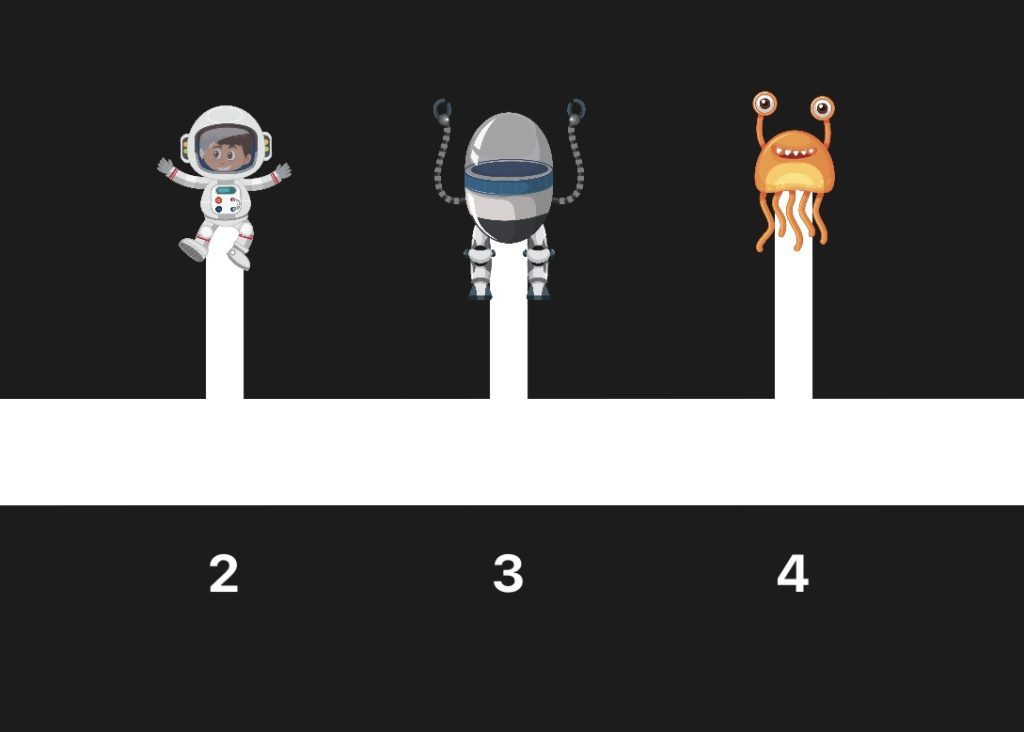
Mastering Both Math and Space with the Cosmic Number Lines App
An accessible, engaging iOS game, the Cosmic Number Lines App was designed for early elementary school students who are blind...

Mastering Math with Cedric’s Cartesian Quest
A new quest for students taking on new math skills has just begun with the Cedric’s Cartesian Quest app! This...
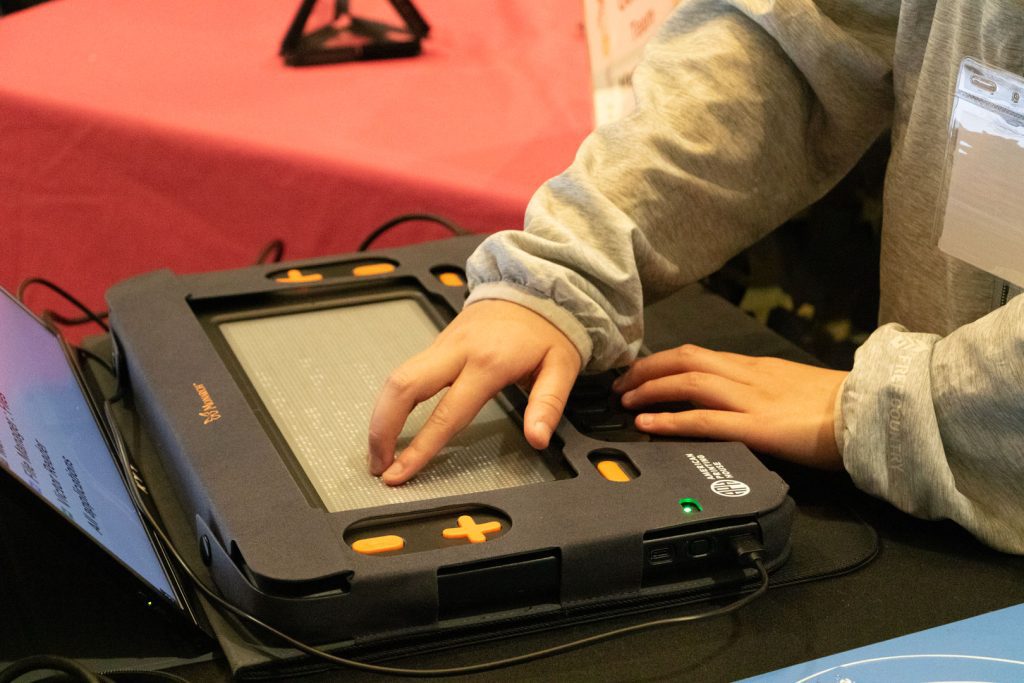
Making Math More Accessible: Monarch’s Word Processor
Standardized testing scores among students who are blind and have low vision are very low in STEM subjects. When APH...