Buy your tickets to The Dot Experience today. Doors open October 30.

Hall of Fame: Leaders and Legends of the Blindness Field
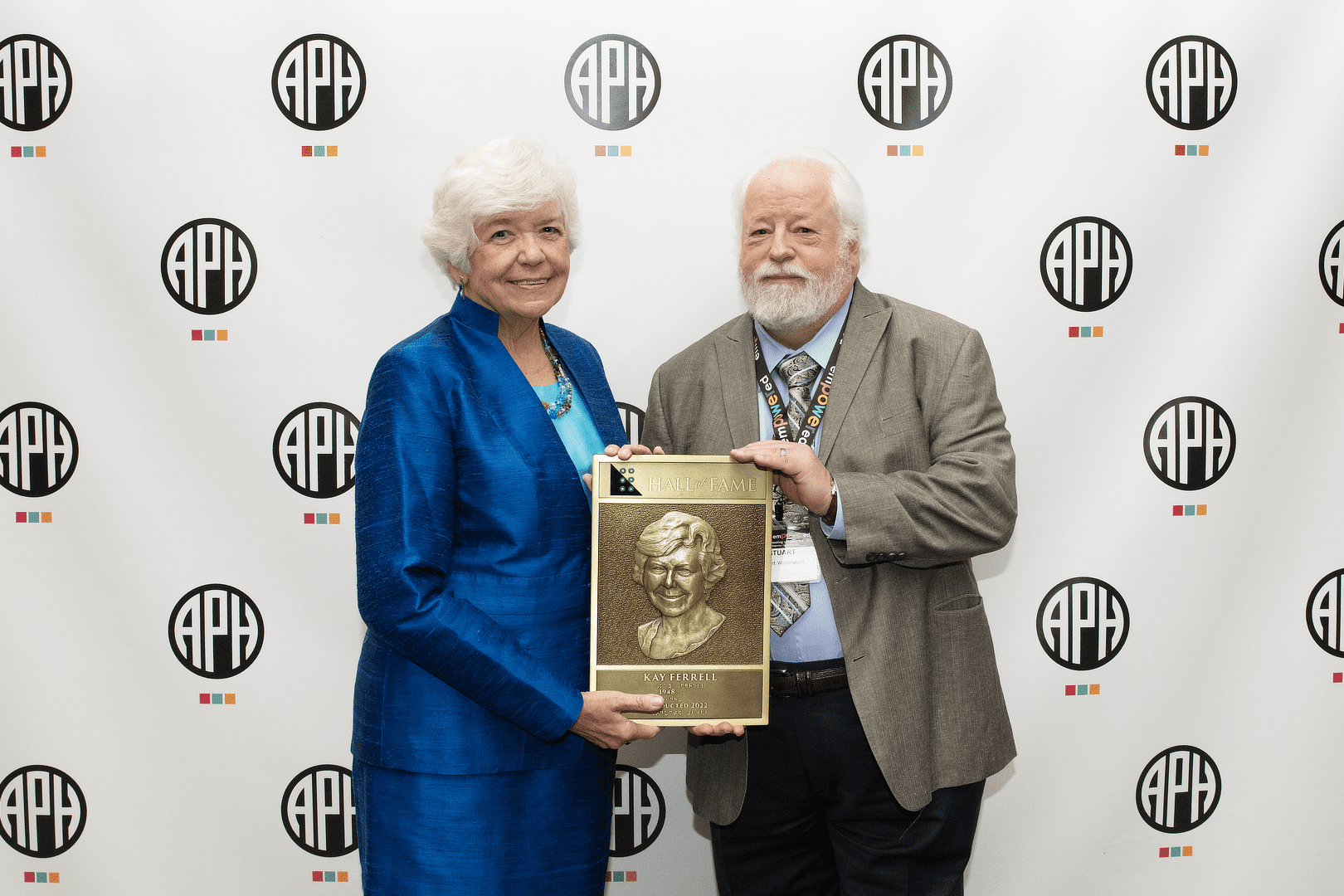
The Hall of Fame for Leaders and Legends of the Blindness Field preserve, honor, and celebrate the tradition of excellence manifested by individuals inducted into the Hall of Fame for outstanding services to persons who are blind and visually impaired. Inductees are honored at a ceremony and exhibited in a special location at the American Printing House for the Blind.
About
Members of the Hall of Fame make up a fascinating cross-section of heroes and pioneers who shaped our rich history, philosophy, knowledge and skills. These giants shared their personal lives and showed strategies to ensure services remain unique and specialized for people who are blind and low vision.
The establishment of the Hall of Fame for Leaders and Legends of the Blindness Field was announced in Louisville, Kentucky, in October of 2001 at American Printing House for the Blind’s (APH) Annual Meeting of Ex-Officio Trustees. The Hall has gained support from across the field, including from AER, AFB, and CEC-DVI. The Hall of Fame is housed within APH’s museum, The Dot Experience.
We welcome your contribution.
Find the Hall of Fame on Facebook and YouTube. You may also contact the Hall of Fame by sending an email to [email protected]
-
The Hall of Fame for Leaders and Legends of the Blindness Field nominations for 2026 inductees is closed.
What are the Criteria?
A nominee has made transformative and sustained contributions to improve the lives of persons who are blind or visually impaired.
Nominations should demonstrate how the individual has met the principal criterion through their contributions in at least one or two of the following criterion areas.
Contributions to the Body of Knowledge
- Curriculum development
- Compelling oral and written presentations
- Editorial service (editor-in-chief, associate editor, editorial board)
- Preparation of new professionals
- Preservice and in-service professional development
- Program development
- Published writing— expository, opinion, or practitioner research
- Published writing—data-based scientific research
Contributions through Leadership and/or Advocacy
- Administrative planning
- Advancement of the blindness community
- Capacity building: Resource development
- Capacity building: Revenue generation
- Community organizing
- Information dissemination (public)
- Interagency collaboration
- Parent and family organizing and advocacy
- Public policy (federal, state, local)
- Public relations/public image
- Service in and through professional or consumer organizations
- Staff and parent development
- Systems change
Contributions as Mentor or Role Model
- Admired for one’s intellect, moral courage, and/or strength of convictions
- Provided guidance, trustworthy advice, and support to consumers, professionals, or parents
- Served as a change agent
- Served as a model for others, through one’s behavior, example, or success
- Served as a motivational role model for independence
- Supported others to achieve their goals
Contributions through Professional Practice
- Assisting practitioners and/or administrators
- Exemplary and transformative direct service
- Impactful presentations
- Innovative practices
- Provision of education and/or specialized services to infants, children, adults, and older persons and their families
- Sharing knowledge and experience
- Visionary and strategic planning and implementation
Innovative and Pioneering Contributions in the Field of Blindness and Visual Impairment
- Access technology
- Adaptive equipment
- Educational methodologies
- Pharmaceuticals and other medical interventions
- Software development
Exemplars with auto download to your computer
Who is Eligible?
- Persons are eligible five years after departure from positions where their significant lifetime body of work was made.
- Individuals from North America, living or deceased, are eligible for nomination. (North America is defined as US, Canada, Mexico, and the Caribbean).
What is Required to Nominate Someone?
To nominate an individual for consideration to be inducted into the Hall of Fame please submit the following to the Hall of Fame, Kim Zebehazy, Secretary, at [email protected] by the deadline. Please put 2026 Hall of Fame Nomination in the subject line of your submission and send all materials together.
- Cover letter that specifies the one or two criteria areas that best captures the nominee’s contributions to the field of blindness and visual impairment.
- Completed Nomination Form organized around the principal criterion. Click one of the links to auto download your format of choice to your computer:
- A resume or curriculum vitae, if available.
- Two letters of support that concisely emphasize the criteria recommendations.
How long do nominations remain active?
- Nominations that are not selected are held and reconsidered the following year. Nominators are allowed to update and refresh the original nomination.
- If not chosen in the second year, nominations must be resubmitted as a new nomination.
-
The 2026 induction ceremony will take place during a general session at the international conference of the Association for Education and Rehabilitation of the Blind and Visually Impaired (AERBVI) on Friday, July 31, 2026, at 1:45 p.m. in Louisville, Kentucky. A bas relief plaque of each inductee will be added to the Hall of Fame located at the American Printing House for the Blind.
The 2026 inductees are:
Janet Barlow
Janet Barlow is widely recognized for her leadership and advocacy in the field of orientation and mobility (O&M) and accessible pedestrian systems. Her work has helped improve accessibility, safety, and independence for individuals who are blind or visually impaired throughout North America and internationally.
Deborah Chen
Deborah Chen has devoted her career to advancing educational opportunities and professional standards for individuals with visual impairments, particularly students who are DeafBlind or with multiple disabilities. Her leadership and mentorship have strengthened services and inspired professionals within the blindness field.
Penny Hartin
Penny Hartin is known for her tireless advocacy in advancing access, inclusion, and the rights of individuals who are blind at a global level. Her work as Chief Executive Officer with the World Blind Union positioned her to support and promote alliance building and coordinated action across organizations.
-
A
Georgie Lee Abel
Edward Ellis Allen
Lulu (Lou) Johnson Alonso
Loyal Eugene Apple
Samuel Ashcroft
Robert Atkinson Carl Augusto
Carl AugustoB
Samuel Bacon
Edwin Albert Baker
Janet Barlow
Natalie Barraga
Mary K. Bauman
Donald Blasch
Warren BledsoeC
Charles F.F. Campbell
Sir Francis Joseph Campbell
Thomas Carroll
Deborah Chen
Michael CollinsD
E
F
Eleanor E. Faye
Kay A. Ferrell
Martha Louise Morrow Foxx
Morris Frank
Sir Charles Frederick FraserG
Kathern Gruber
H
William Allen Hadley
Frank H. Hall
Verna Hart
Penny Hartin
Phil Hatlen
Euclid Herie
Everett “Butch” Hill
Richard Hoover
Samuel Gridley Howe
Kathleen M. HuebnerI
J
Kenneth Jernigan
Laurence C. Jones
Randall T. JoseK
Ruth Kaarlela
Helen Keller
Alan Koenig
Roy KumpeL
M
Ann MacCuspie
Sally Mangold
Durward McDaniel
M.C. MigelN
P
R
Alice Raftary
Louis Rives
Sally RogowS
Peter Salmon
Ambrose M. Shotwell
Robert J. Smithdas
Susan J. Spungin
Anne Sullivan
Stanley Suterko
Mary SwitzerT
Josephine Taylor
Tuck Tinsley
Dean TuttleV
W
William Bell Wait
Donald Wedewer
Richard Welsh
Robert H. Whitstock
Russell Williams
James Max Woolly
Berdell “Pete” WurzburgerZ
-
Mike Bina, Chair
Julie Hapeman, Vice Chair
Kay Ferrell, Treasurer
Kim Zebehazy, Secretary
Bill Wiener, Past ChairMembers-At-Large
Bernadette Kappen
Mary Nelle McLennan
Mark Richert
Lee Nasehi