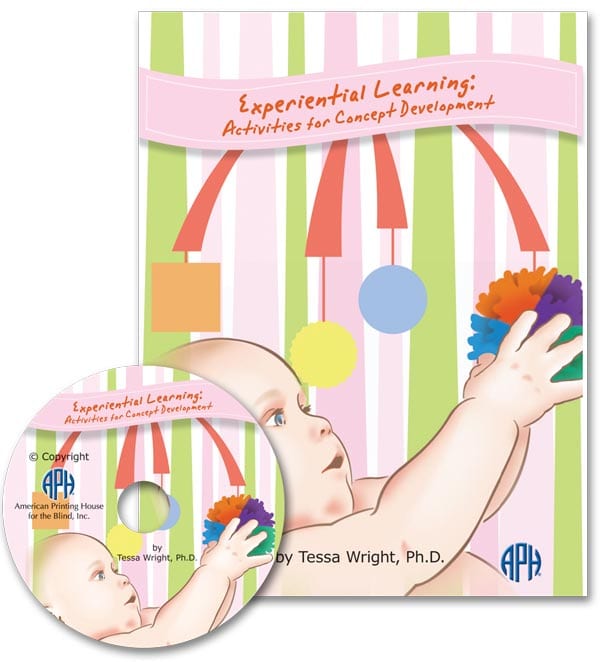
Activities in this guidebook are designed to help children learn through experience in a meaningful and fun way.
Six developmental areas are addressed: cause and effect, hand-eye coordination (auditory-hand coordination), motor development, object permanence, sensory awareness, and spatial awareness. These are not the only areas where children can learn through experience. These concepts and skills, however, are six of the primary areas that need to be promoted in infants and young children with visual impairments.
Definitions for development areas:
Cause and effect — the understanding that one action or event causes another
Hand-eye coordination — the ability to use visual input to control and guide the movement of the hands to perform a task
Auditory-hand coordination — the ability to use sound localization skills to control or guide the movement of the hands to perform a task
Motor development — the growing ability to control and engage in fluid, purposeful bodily movements using large and/or small muscles
Object permanence — the notion that when an object is out of the realm of immediate experience through sight or touch, the object still exists
Sensory awareness — the development of sensory channels through opportunities to experience and explore the developing senses of touch, hearing, smell, sight, and taste
Spatial awareness — the understanding of where things are in space and how they relate to one another closely related to object permanence
Each section of Experiential Learning contains a brief overview of the skill or concept being addressed. This overview is followed by three suggested activities: a beginning, intermediate, and more advanced activity for each area.
User provides toys: The service provider or parent must provide the toys and other materials to be used in each activity. These items should be preferred by and appropriate for the specific child. Such items include toys that produce sound, a mobile or play gym, and objects that can be suspended from the mobile or play gym. A list of suggested materials/items suitable for the activities are provided in the back of the guidebook.
Recommended ages: while this product is designed for children ages birth to 3, who are blind and visually impaired, the activities are also appropriate for children of any age working on the aforementioned six developmental areas.
A free, accessible pdf version of the activity guide is available in the “Manuals & Downloads” section below.
Guidebook for STACS: Standardized Tactile Augmentative Communication Symbols Kit. Shipping Limitations: This product only ships to the United States. Orders…