The Dot Experience is now open! Buy your tickets today.

Monarch is Making a Difference: Bill Adams’ Story
November 11, 2026
William “Bill” Adams is a Blind Rehabilitation Specialist at the U.S. Department of Veterans Affairs in Birmingham, Alabama. While his primary focus is orientation and mobility (O&M), he also teaches assistive technology and communications. His goal is to empower Veterans to travel confidently in a variety of environments, enhancing their independence and quality of life.
Born with albinism, Adams lost his sight at the age of 20 following a traumatic brain injury. After earning a bachelor’s degree in political science and justice from Kent State University, he moved to Alabama to work for the VA. He later earned his master’s degree in orientation and mobility from Western Michigan University, as well as a Certificate of Graduate Study as an Assistive Technology Instructional Specialist.
Discovering the Monarch
Adams first learned about the Monarch RISE Project through newsletters from the American Printing House for the Blind (APH). He had also followed Monarch since its early stages of development after it was introduced at the CSUN Assistive Technology Conference several years ago. Adams received his Monarch as part of the first RISE cohort and is a member of the advanced technology group.
He frequently uses the Monarch with the Veterans he works with, whether drawing tactile graphics with the Wing It app, opening files from the Tactile Graphic Image Library (TGIL) or playing Wordstock with Veterans if they are feeling anxious after a street-crossing lesson. He has even taught someone how to program using the Monarch. “One thing you lose with a one-line braille display is the syntax,” Adams said. “Being able to show everything on multiple lines, such as indentation and nesting commands, is a game changer.”
Changing the Game at the VA
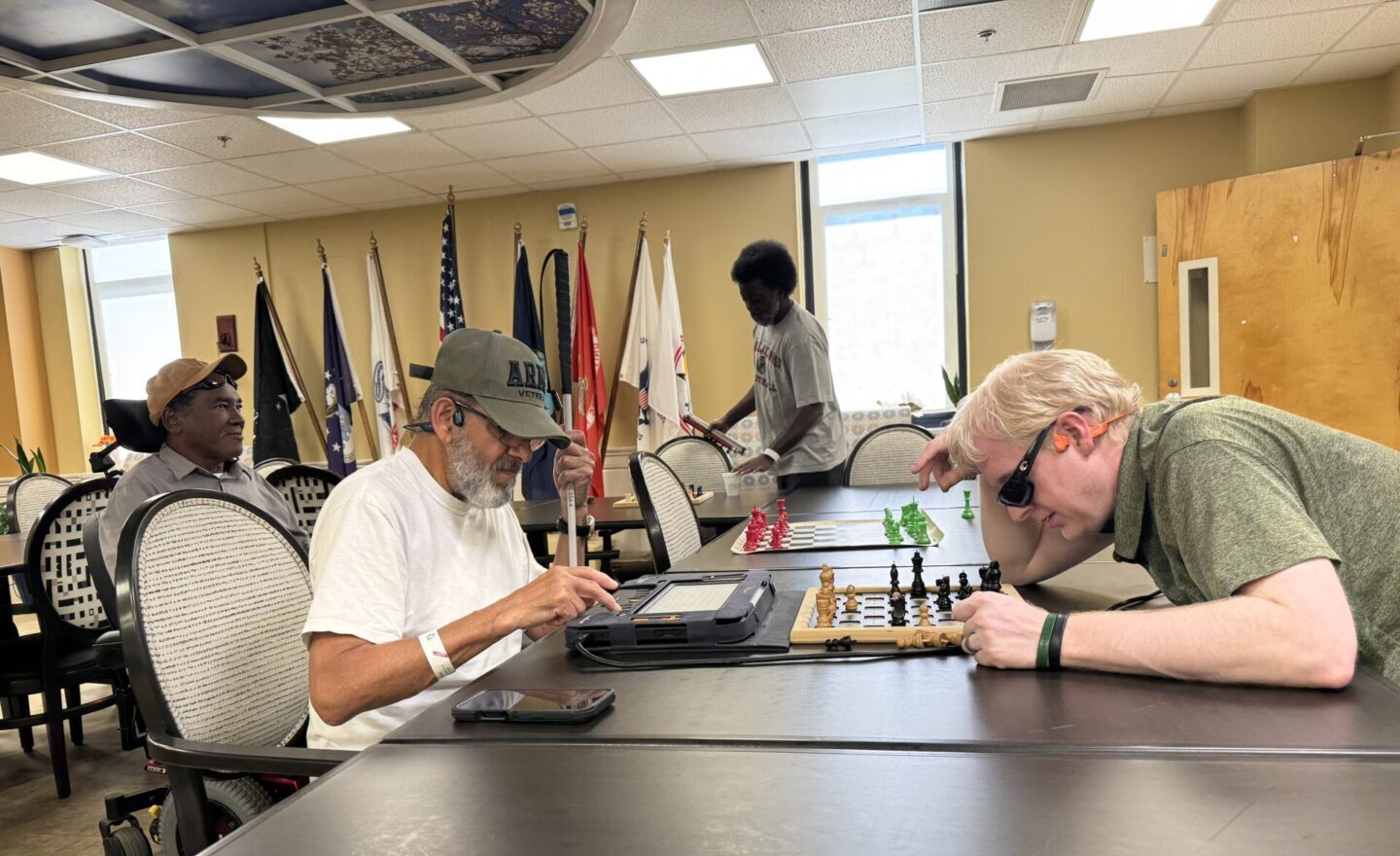
Recently, Adams organized a chess tournament for the Veterans at the VA using the Monarch Chess app. With only one Monarch available, staff connected the device to a video wall so Veterans with low vision could follow the matches. “Even though we only had one, they were always asking when they were going to get their turn on the Monarch,” Adams said. “Whoever won got to play on the Monarch.”
Today, chess is part of the regular recreation rotation at the VA. Veterans use several high-contrast, tactile chess boards alongside the Monarch. “Most of our Veterans don’t know braille,” Adams said. “Many have diabetes or retinopathy and haven’t had the opportunity to learn it, but they can still figure out what things mean on the device. The Monarch is still useful.” When asked what excites him most about the Monarch, Adams’ answer is simple. “The endless possibilities,” he said. “It’s ever-expanding. That’s the main difference.”
The Future of Tactile Learning
Adams describes the Monarch as a tactile computer. Even when he doesn’t need to create graphs, he enjoys exploring tools such as the graphing calculator. He is eager to see future developments and looks forward to the possibility of Monarch displaying full stock charts or weather maps. “Something like that would have been nice to show the Veterans when Isaias came through,” Adams said. He also hopes Monarch will one day help bridge the gap between visual memory and tactile understanding. “People miss that stimulus,” Adams said.
Adams believes Monarch can increase access to tactile learning and discrimination skills instead of relying only on audio. “Outside of the VA, manual skills, those skills of using your hands to understand things, aren’t really taught anymore,” Adams said. “Another thing we’ve seen go down is braille literacy. Monarch has the ability to expand eBraille.” One example, he said, is the reading experience. “I can feel that there’s a link and know it will open when I double tap the button,” Adams said. “I’ve not seen that with other multi-line braille displays.”
The Monarch continues to break down barriers and open fields for more blind or low vision students. To learn more about Monarch, visit our Meet Monarch page. To read more stories like Bill’s, visit some of our blogs linked below!
The contents of this blog were developed under grant #H421F240052 from the U.S. Department of Education (Department). The Department does not mandate or prescribe practices, models, or other activities described or discussed in this document. The contents of this blog may contain examples of, adaptations of, and links to resources created and maintained by another public or private organization. The Department does not control or guarantee the accuracy, relevance, timeliness, or completeness of this outside information. The content of this blog does not necessarily represent the policy of the Department. This publication is not intended to represent the views or policy of or be an endorsement of any views expressed, or materials provided by any Federal agency (EDGAR 75.620).
Share this article.
Related articles

The Gift of Time
Early in 1943, the American Foundation for the Blind (AFB) started a program to help soldiers blinded in World War...
Finding Sadie
“The blind veterans here in the Helen Keller class are able, thru talking books, to obliterate the tedious hospital hours...